Flipping over to the New Year on the desk calendar, there’s nothing guaranteed to age you more than a list of anniversaries of things that turn 20 in 2015 except, perhaps, the list of things that turn 30.
Can it really be two decades since the DVD was invented? The year 1995 also gave rise to the Macarena and JavaScript, and the first Toy Story movie was released.
Hugh Grant was infamously caught with a prostitute named Divine Brown on Sunset Strip in Los Angeles, engaged in what Time magazine called “felonious fellatious activity’’, and OJ Simpson was tried and acquitted.
Really, I hear you say, was it that long ago?
Rewinding further, to 1985, Michael J. Fox first took us Back to the Future, Nintendo released Super Mario Bros, and the very first version of Windows, Windows 1.0, opened up a whole new world.
This year also marks the 30th anniversary of Neighbours. The soap opera set in Ramsay Street, in the fictional Melbourne suburb of Erinsborough, first went to air on Channel Seven on March 18, 1985.
It failed miserably in the Sydney market and, in a decision that doubtless still haunts certain erstwhile executives, Seven scuppered it.
The show was immediately bought by Channel Ten and went on to become not only the longest-running drama series in Australian history, but arguably our most influential cultural export.
Paul Hogan’s Crocodile Dundee may be Australia’s best-known cinematic character, but Neighbours took up permanent residence in people’s lounge rooms and hearts, having been sold to 57 countries from Austria to Zimbabwe. Nowhere was it better received than in Britain, attracting up to 20 million viewers at its peak in the late ’80s.
First appearing on TV screens in the bitter economic winter of the Thatcher years, the Aussie soap offered a ray of sunshine and much-needed escape for Britain’s disaffected youth.
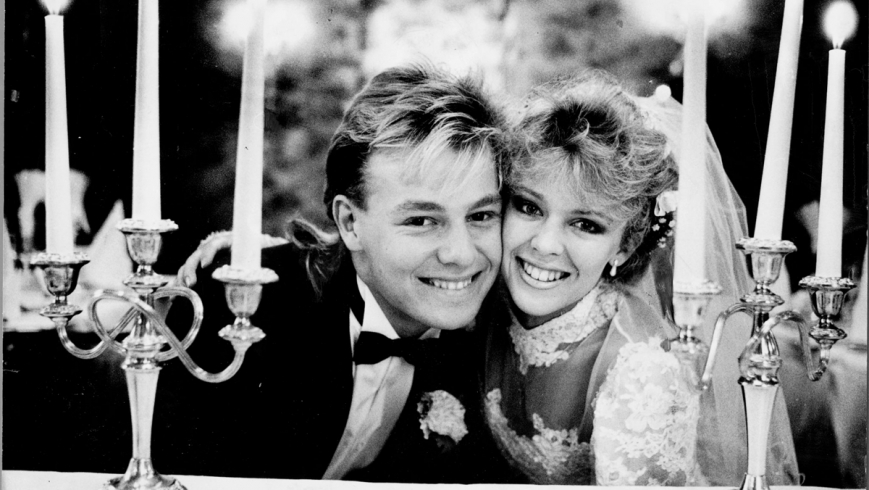
Its stars, Kylie Minogue (Charlene Mitchell) and Jason Donovan (Scott Robinson), dominated the British pop charts with I Should Be So Lucky and Nothing Can Divide Us respectively, while their duet Especially for You stayed in the charts for 14 weeks.
Even Suddenly, the Angry Anderson power ballad that accompanied Charlene and Scott’s wedding, made it to No. 3 on the British charts on the strength of the soap’s popularity.
It was the start of an Aussie invasion that went well beyond the backpackers of Earls Court. As Alwyn W. Turner noted in his book Rejoice! Rejoice!: Britain in the 1980s, Australian wine overtook sales of French wine and the rising inflection entered speech patterns.
But much more than promoting the sunny image of Australia, Neighbours has gently helped educate viewers with sometimes-controversial storylines tackling issues of domestic abuse, teenage pregnancy, alcohol, drug and gambling addiction, incest, eating disorders, bullying and depression.
In recent years it has also included openly gay and more culturally diverse characters to better reflect modern Australia.
It may not be breaking new ground, nor tearing up the ratings any longer, but the soap models an inclusive society centred on family and community.
Which is why, after three decades, Neighbours can still be called good friends.