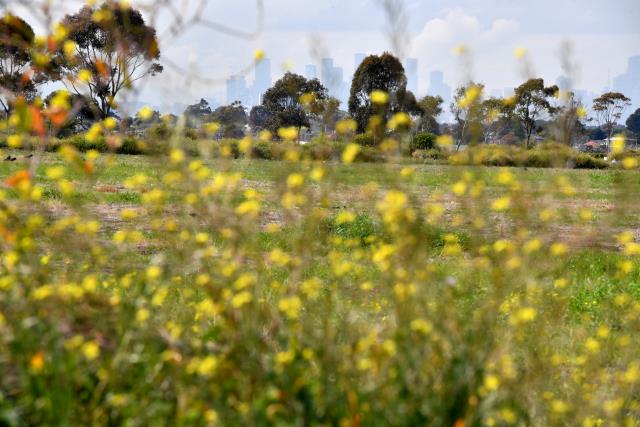
At Solomon Heights in Sunshine North, 430 privately owned lots have remained undeveloped for a century.
Former Brimbank mayor and president of Brimbank Progress Association Bruce Lancashire said the estate is “Melbourne’s worst example of urban blight“.
“It’s been a subdivision that’s been sitting there for 100 years without the owners having a reasonable expectation of developing their land,” said Mr Lancashire – who is also a qualified town planner and civil engineer.
Land in the estate is owned by a mix of private individuals and companies.
Brimbank council acts as the responsible authority and planning authority for the subdivision, and owns roads in the estate’s north.
Council highlights multiple issues impacting the development of the industrially-zoned precinct, one of which is the presence of critically endangered flora and fauna species protected under federal and state laws.
Of these species is the spiny rice-flower – a small plant with spike-tipped stems and pale yellow flowers.
There were 436 spiny rice-flower plants recorded in Solomon Heights in 2021, as previously reported by Star Weekly.
However, Grassy Plains Network Victorian national parks association facilitator Dr Adrian Marshall expects this number has since decreased.
“The owners haven’t been managing the grasslands, which includes the spiny rice-flowers, so it’s been in slow decline,” he said.
“It’s illegal to bulldoze grassland but if you just let the weeds take it over it’s perfectly legal. It’s really frustrating.
“[The flowers] are really important. It’s as close to extinction as it can get.”
To protect native flora and fauna in the estate, Mr Lancashire believes council should support the position of environmental offsetting across the entirety of the estate, which he said would allow development to progress.
Environmental offsets compensate for significant biodiversity losses by securing land at another site where an ecosystem can be maintained and protected over a period of time.
“There’s an opportunity here for council to be highly innovative,” Mr Lancashire said.
Brimbank council city futures director Kevin Walsh said council has no plans to pursue acquisition of land for environmental offsetting.
Mr Walsh also said council isn’t considering any proposals for offsetting or overlay schemes at this time.
“Council will continue to advocate to the federal and state governments and other entities to achieve an appropriate outcome to protect environmental values of the Solomon Heights precinct,” Mr Walsh said.
A 2016 report prepared by environmental consultancy firm biosis suggested offsetting to occur in a proposed conservation area in the estate’s north, which would allow the southern half to be developed.
Dr Marshall agrees this is the best solution.
But he also said the conservation area would likely result in unfairly distributed profits as land owners in the estate’s south would be able to retain their lots in the prime location.
Dr Marshall believes the state government should step in and create a large-scale precinct plan for the estate to satisfy all land owners.
“Unless somebody owns it all, it’s like the landowners in the northern half will end up with a lot of money lost, and the southern half will gain a lot of profit. That’s why it has to be a large-scale solution,” Dr Marshall said.
“What we need is a process where the government steps in and does a plan for the whole area and does an equitable distribution of profit.”
A state government spokesperson said matters relating to the future use of the site are for Brimbank council.
“Any proposal by council to rezone the land would be considered on its merits,” the spokesperson said.