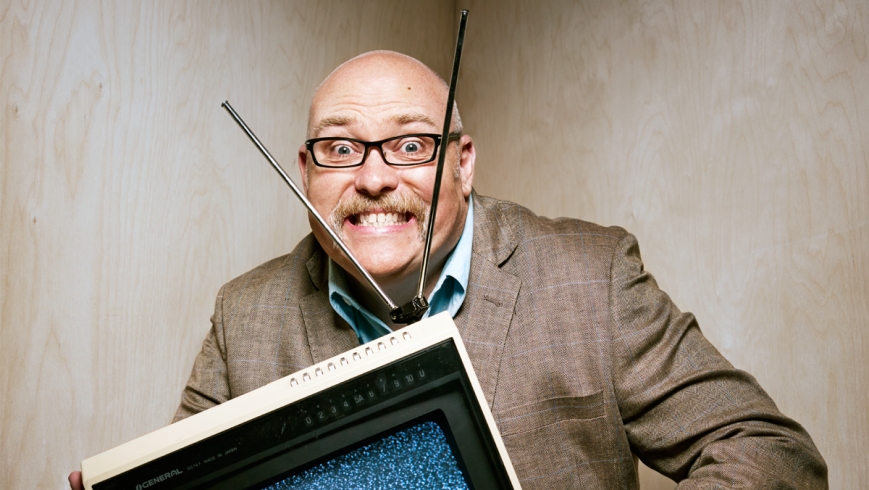
It’s the type of laugh that is a blessing to a performer: one that you want to laugh along with, and in this case it’s almost impossible not to. Adam Richard’s laugh arrives often, a wicked outburst, and in our time together it frequently follows a story or thought relating to something less than ideal that happened in his life.
And what a life it’s been. Now an overnight national identity on the ABC’s rebooted Spicks and Specks, Richard, 43, tells a story of an absent and occasionally violent father, a brotherly need to protect his younger sister from domestic upheaval and an often wild teenagehood around Brunswick and Carlton.
I’ve met Richard in a St Kilda café, where he tells a horror story about his days as a radio and gossip reporter, first for Triple J (where he was known as Mister Bitch) and then for 10 years from 2003 on Fox’s The Matt and Jo Show. He’d interviewed Sandra Bullock for her film Miss Congeniality 2 – “a terrible film” – and “the audio recording went horribly wrong – my voice was on there but hers was not”. The café echoes with that huge laugh.
Richard – born Adam Richard Dellamarta – grew up in Brunswick and went to school in Carlton. “It was good and bad,” he says. “It was becoming gentrified but there were still the [housing commission] flats there so it was a real mix of people. There was myself and a whole bunch of really poor kids, then there were more middle-class kids. There was the money to buy drugs and then access to them from some of the more revolting members of society, people’s older brothers, and things.
“A couple of school friends died, one at high school, which was a really horrible experience. He drowned at the Fitzroy pool. He used to break in at night and drowned one night. After school there were a couple of heroin overdoses. A couple of friends have only just come out of decades of drug abuse.”

So he was running with a wild pack. “Yeah, a little bit. I was terrible myself. I was very badly behaved.” What did he do? “Anything and everything. It’s a miracle I’m still breathing and walking on this earth. Drugs. On one hand, I’m glad I got that out of my system at a young age. I would hate to be attempting to have a career now and also being self-destructive. It stopped me going to uni, which was terrible.”
Home life was tough. His father, Fred, worked in various jobs, including as a bartender and a cleaner. “I worked with my dad when I was 10. He used to clean the John Curtin pub in Carlton and he would take me with him and he used to get me to do the vacuuming.”
Richard’s father died in 2006. I ask about their relationship. “Awful. Now I can see that he was clearly depressed and had some terrible issues. He was angry, violent, he had a gambling problem, a terrible drinking problem. And two kids who just seemed to be in the way all the time. It was not pleasant.”
Did he reconcile with his father? “No. He rang me after I started doing stand-up [in 1996]. I think I saw him once or twice when I got back from overseas in the early ’90s, but not really later in life.
“He died in Ararat, of all places. Apparently out on some farm, which I think was full of people who had just got out of prison down there. He used to travel with a fairly horrific crowd.”
His father’s funeral was a strange experience. “It was really odd because I’d just received an email from [a family member] who said, ‘I don’t know if you know, but your father’s quite ill’. And by the time I’d managed to find him, he had just passed away. He’d gone to hospital. He’d lost a leg, from smoking and drinking – so, gangrene – and died not long after that. At the funeral the coffin looked like a flat pack from IKEA. It was this weird moment when I just went, ‘All I feel I have from that man is some DNA and quite a lot of damage’. And there he was in this terrible box.
“I just felt that we had nothing in common. He exerted a lot of pressure on me to leave school early and learn a trade, and I was interested in further education. I started to get a real sense that he felt threatened by my intelligence. He was somehow scared of me on an intellectual level. And the only way he knew how to deal with that was physical.”
Did his father hit him? “Once or twice. He was an alcoholic. There was punishment. And in the ’70s punishment was often physical. You could do something horrendous and he’d laugh at it, and then you’d do something you thought was fine and you’d get in trouble for it. Kids don’t understand. So you end up as an adult constantly testing boundaries, which can be fatal in some instances.”
Richard was open about being gay when quite young. How did his father react to his son’s sexuality? “He was not around for that conversation.” Did he ever know? “He must have. I found some photos and articles about me in his meagre possessions, so he would have known. But I don’t know what his reaction was.”
Did his father find him funny? “Occasionally. I was always fairly flamboyant, even as a 10-year-old.”
He thinks now his experiences with his dad might have fuelled his desire to perform or be funny.
“When dad was happy, everybody was happy. So if you could manage to entertain him on some level it became like a survival mechanism.”
When he was 16 he dropped the name Dellamarta, and changed his name by deed poll in 1996 after his mother died. “I didn’t really like my father and I didn’t feel a connection with the paternal side of my family.
“I was considering changing it to my mum’s maiden name but then I thought the names that I was given, they’re my names. The other one is what I inherited from some people I don’t really know. It wasn’t really an important name for me.”
When Richard was aged 18 and in year 12, his mother decided to leave the family home with Richard and his sister. Richard felt a responsibility to protect his sister, who is two years younger. “I kind of assumed that I would have to take my sister away from that situation at some point,” he says.
He’s survived some pretty horrendous stuff. “I really don’t want to talk about it that much because I feel like I don’t want anyone enjoying my work out of pity,” he says. “It’s the same thing about being gay. While it’s something that I want people to know – that I’m gay – I don’t want to work only to gay crowds. I don’t want to just be hosting pride marches and Midsumma carnivals. I’ve insisted on working almost exclusively to mainstream crowds.”
Was he bullied over his sexuality? “Oh yeah, but that was because I was quite open about my sexuality from the age of 16.” Was it challenging to be open at that age? “Not really. Inner-city school, and it was the age of Boy George and gender-bending, Annie Lennox. There was this androgyny going on, so there was a lot of talk about being gay. And everyone I identified with on television was gay, like Mr Humphries in Are You Being Served? and Uncle Arthur from Bewitched. All the campest people were my favourite people on TV. It seemed stupid to pretend not to be.
“There were a couple of people who weren’t OK with it and were angry about it, but there was little to no violence. I think someone hit me once at a party but I may have been horrific at the time. I’m pretty horrific.’’
He says he has experienced more homophobia as an adult. “In the last couple of years with the marriage equality debate, people feel it’s an open forum to just tear strips off my entire sexuality. Any gay person – we’re meant to just weather the storm of the horrendous things that are said in a so-called debate.
“People who don’t think a segment of society should be equal are allowed to espouse all sorts of views that are unscientific and unfounded and based entirely on fear. I have to pay full taxes, I’m allowed to vote. I’ve got my driver’s licence, I own a house, I pay my rates, but I’m not a full citizen of this country.”
He did go to university – studying cinema – for just four weeks. “I was enjoying partying far too much to be at La Trobe University talking about Doris Day.” After a brief stint working in a bank – “I was terrible at it” – he headed to the UK. He was 19, living in a town called Basingstoke and cleaning toilets in an office block. Later he sold baked potatoes in a food court at a place called Spudulike. It wasn’t where he wanted to be.
“I wanted to be a writer since I was five. I did a course in London, studied comic book writing. I’m yet to publish a comic book.”
For years he has experienced panic attacks and palpitations. “They’re awful. I just keep going. When you’re performing you’re not really you. You’re a performer. Even in a conversation.
“So I can have a panic attack and carry on blithely, like it’s not actually happening.
“In our society we think about mental illness like it’s something to be ashamed of and something to hide away from. And that’s where the problems really can manifest themselves, when people don’t get help.”
He has strong views on how overweight people are treated. “I try and diet, I try and exercise, I try and do all these things, and I still keep getting big,” he says. “And I use food in a way that I used to use illegal drugs, in that it’s a way of managing the serotonin levels, I guess. Eating disgusting food makes me happy on a purely physical level.
“Emotionally I don’t really enjoy it, but I feel satisfied when I eat bad food. But then I eat through the barrier of being full. I just keep eating. And that, essentially, is an eating disorder. But when you look at a fat person all you think is, ‘Oh, they’ve got no control, no restraint’, and when you see someone who’s anorexic you think, ‘Poor person, they’ve got so many emotional difficulties’. Obese people have the same emotional difficulties, but we just see fat people as disgusting.
“And shows like The Biggest Loser don’t help. They imply that it’s something you can just get over – go to the gym, eat three pieces of lettuce, you’ll be fine. They don’t really deal with the emotional problems. If you don’t deal with upstairs, then downstairs is going to be a mess.”
Richard has been a guest several times on Spicks and Specks and now joins host Josh Earl and fellow team captain Ella Hooper on the reboot. He’s excited about the role. “I remembered how warm and generous the captains were when I was a guest on the show and I thought, ‘I’d love for someone to be able to think that about me, that I’d provided a really nice, warm comfortable space to perform’.”