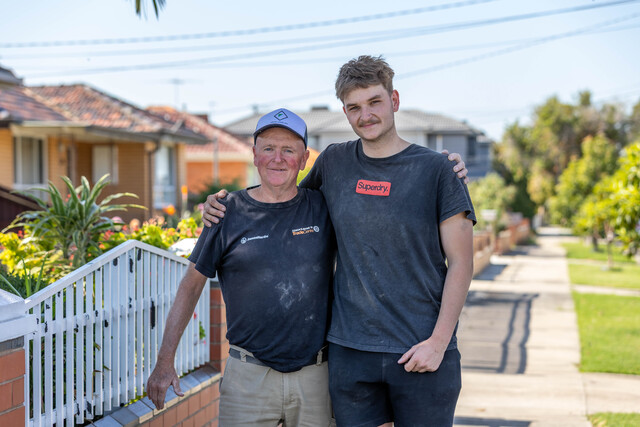
It wasn’t the first day at work Connor Walker expected, with the 20-year-old labourer giving cardiopulmonary resuscitation (CPR) to his new boss to help save his life after a cardiac arrest.
Brad Allport, 63, remembers feeling unwell while having lunch with Connor. But that’s where his memory ends.
“He said he was getting a bit hot, then he dropped to the floor,” Connor said.
“I picked up his head and tried to wake him up and then I saw he was struggling to breathe.
“I called triple-0 straight away and moved him onto the floor and they told me to start CPR.
“I didn’t really know what to do, I was in shock. I just wanted him to wake up.”
Brad was in cardiac arrest – when a person’s heart suddenly stops pumping blood effectively around the body.
Connor’s quick action was critical. In a cardiac arrest, for every minute that CPR is delayed, survival decreases by 10 per cent.
A Fire Rescue Victoria (FRV) crew from Station 51 (Keilor) soon arrived at the scene as part of the Emergency Medical Response (EMR) partnership with Ambulance Victoria (AV), which aims to improve cardiac arrest survival rates by dispatching firefighters at the same time as an ambulance to ‘priority 0’ cases.
FRV station officer Elisabeth Andrew was first on scene.
“We delivered one shock with a defibrillator and recommenced CPR. Not long after the shock was delivered, Brad started to respond,” she said.
AV paramedics, including Mobile Intensive Care Ambulance (MICA) paramedics, gave Brad medication and oxygen as his condition rapidly improved and transported him to Sunshine Hospital.
Paramedic Peter Bollas said the sequence of events gave Brad the best chance of survival.
“This case was a classic example of how the chain of survival saves lives – with early recognition of the cardiac arrest, early CPR, early defibrillation and early advanced life support,” he said.
“Connor was pivotal in Brad’s outcome – recognising that something serious was wrong and starting CPR early most likely saved Brad’s life.”
Elisabeth said this case was a great example of how FRV work alongside AV.
“FRV responds to approximately 10,000 medical calls per year in support of AV, helping increase patients’ chance of survival,” she said.
Just a few weeks later, Brad is now back at work and not experiencing any lasting effects.