
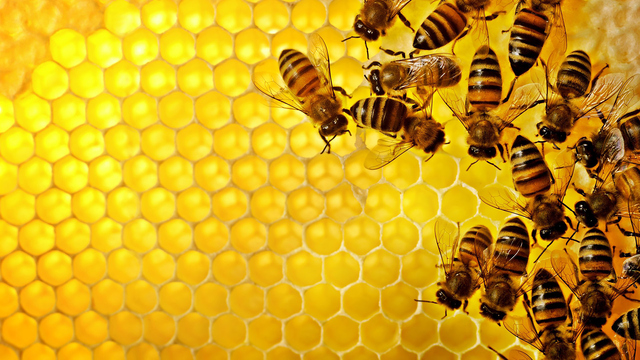
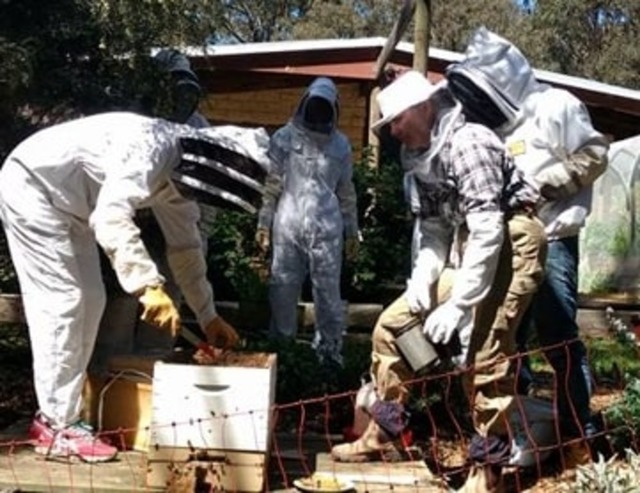
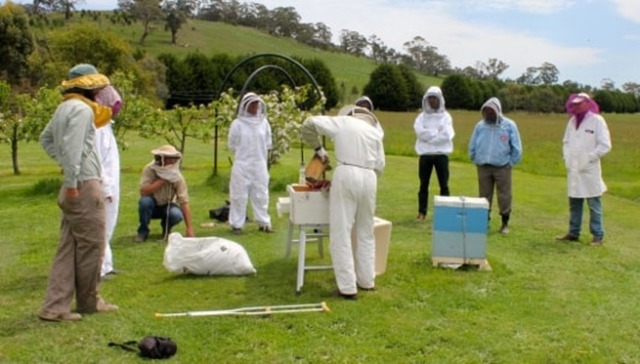
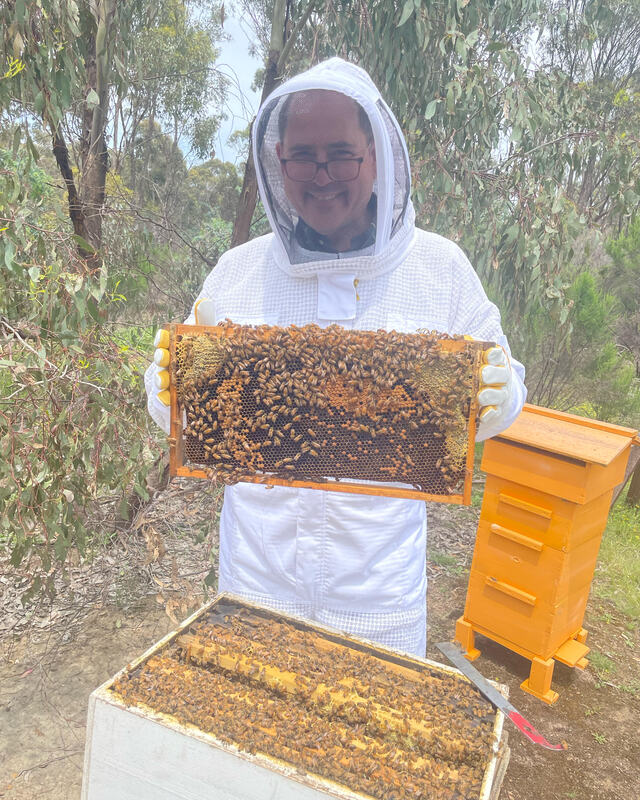
For a group of Macedon Ranges residents, beekeeping is more than a hobby. The members of the Woodend Bee-Friendly Society are committed to providing the best environment for their bees while also protecting the environment. Oscar Parry spoke to beekeepers to find out more about the role pollinators play.
Beekeeping is more than a hobby – affectionately known as ‘the littlest livestock’, beekeepers are committed to providing the best environment for their bees.
Considering the important role pollinators play, including native bees, beekeepers are considering ways to achieve the most sustainable practices.
The Woodend Bee-Friendly Society, an action group of the Macedon Ranges Sustainability Group, holds monthly meetings for beekeepers to learn from each other and provides several beekeeping courses.
Woodend Bee-Friendly Society action group lead Tino Corsetti said the group’s focus is to promote the best care and hive practices for honey bees, and create a sense of community among keepers in the region.
“The name of our club – the Woodend Bee Friendly Society – is somewhat light-hearted, but at its core, there is a mission we take quite seriously – we want to be friendly to bees and we want to be friendly to each other,” he said.
“Being friendly to our bees means developing the knowledge and skills within our membership so that they can monitor the health and wellbeing of their bees. This includes things like monitoring bee nutrition and, when necessary, providing supplemental feed. It also includes regular hive inspections to check for symptoms of weakness, disease or pests.”
Along with caring for their honey bees, which play an important role in pollination for agriculture, the group also recognises and educates keepers about the potential environmental threats that escaped honey bees can pose.
“Swarm management is a subset of sustainable beekeeping. A beekeeper is responsible for managing their hives to try and prevent swarming. If and when swarms do occur, the beekeeper is responsible for trying to capture and rehome that swarm,” Tino said.
“By the late 1800s, reports indicate that feral honey bee colonies had become endemic in the Australian bush. Feral colonies occupy natural spaces, such as hollow tree trunks, that might otherwise provide a home to native mammals or birds. By working to control swarms from managed apiaries, beekeepers can help limit the number of new feral colonies.”
Because of this, Tino said that responsible beekeeping requires planning and commitment.
“If you decide to go on [holiday] in the spring, summer or autumn for more than two weeks, you would need to think about who is going to inspect your hives while you are away. What happens if your bees swarm while you’re on vacation? Do you have someone who can deal with that situation in a safe and responsible manner?”
Despite these considerations, Tino said the hobby is active and engaging for participants, promoting an appreciation for bees and their colonies.
“It brings a connection to the natural environment in ways that few other hobbies do,” he said.
“Beekeepers come to appreciate how sophisticated and advanced honey bee colonies are at responding to their natural environment and being able to thrive against adversity.”
In the Macedon Ranges, Tino said beekeeping comes with challenges, especially due to the cold climate.
“Because of our cold winters and annual variations in the eucalypt flowering cycles, beekeeping is quite challenging in the Macedon Ranges,” he said.
“The beekeeper needs to understand the role of genetics from different lines and races of queen bee, the availability of sunshine throughout the day and, most importantly, the cycle of plant and tree flowering … to ensure that bees have access to high quality nectar and pollen in spring, summer and autumn.”
The society also aims to educate members on native bees and conservation, where it will be hosting a talk in October on the topic.
Ecologist and native bee researcher Clancy Lester said because native bees play a crucial role in pollinating flora, it is important to consider the environment where you keep honey bees.
“If you’re in an area where there are no limitations with pollen, so say you’re in an area with lots of different flowering plants within a close proximity, then the honey bees won’t compete as heavily for resources with native bees,” Clancy said.
In Australia, there are more than 2000 species of native bees, and they play an especially important role in pollinating the country’s wildflowers and native plants.
On Australian charity, The Wheen Bee Foundation’s website, it reports that “very few of Australia’s 2000 native bee species have been investigated … for their potential contribution to Australian agriculture,“ with honey bees being the chosen pollinator for agriculture-related purposes.
Clancy said insect numbers, including native bees, are declining globally due to factors like unregulated or unrestricted pesticide use, urbanisation, and climate change with its effects on plant flowering times.
He said one of the most effective ways to help native bees at home is to plant pollinator-friendly and indigenous flower gardens.
“There are lots of resources, like … the Wheen Bee Powerful Pollinator Planting Guide, and there’s … one for the volcanic plains in [the] West of Melbourne”
Clancy also said that building ‘native bee hotels’ is a way of helping pollinators in your own backyard – with Clancy himself creating guides on how to build these at home.
He recommends using native and untreated hardwood to simulate native bees’ natural habitat of gumtrees, banksias, and wattles, and using reeds, bamboo, and pithy stems to create habitat for cavity nesting bees.
Clancy said that for efficient pollination, having a diversity of bee species pollinate a flower is most effective.
“If you have 10 different species of pollinator pollinating a flower, that’s going to be more efficient and more effective pollination than if you had 10 visits of the same bee species”
With some native plants, such as kangaroo apples and flax lilies, requiring buzz pollination, creating habitat for native bees can have broad environmental benefits.
“There are species of plants in Australia … that are buzz pollinated … and this is a thing that only native bees can do through sonication – when they vibrate their flight muscles really fast without actually flying.”
Clancy said whether you are a beekeeper with honey bees or you create habitat for native bees in your backyard – both are ways for people to observe pollinators at work.